
StyleSense
Project type: AI-Powered Smart Mirror / School Project
Role: Product Designer, Creative Technologist, UX/UI Designer
Tools: Python, HTML, Gemini API, Figma
Overview
Traditional retail storefronts struggle to capture the attention of passerby, acting as passive displays rather than interactive touchpoints. StyleSense is an interactive smart mirror that bridges this gap by using AI to offer potential customers personalized style validation, transforming window shoppers into engaged customers.
The process
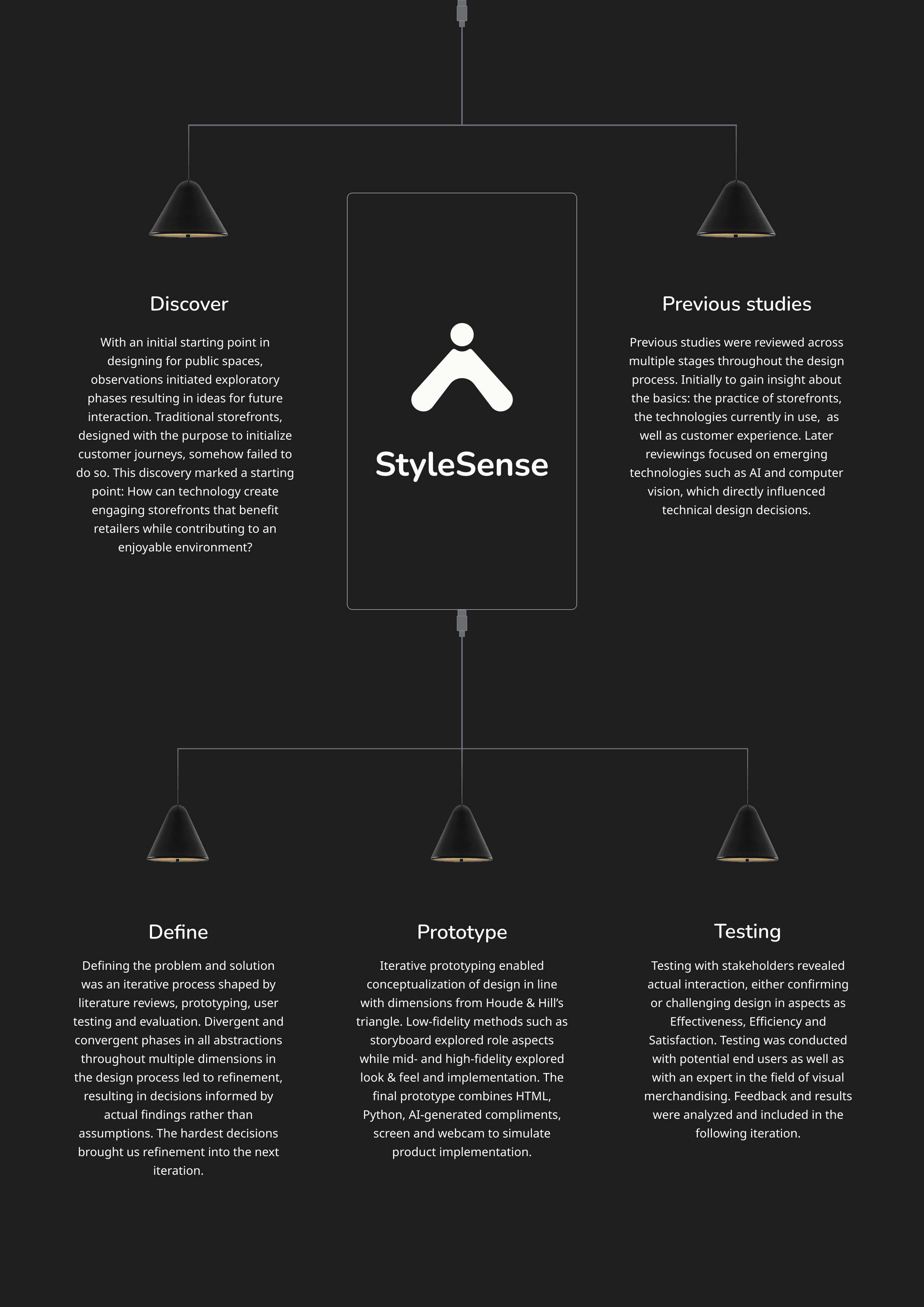
Driven by the Double Diamond process, we moved from thematic research and literature studies to high-fidelity design. Through iterative storyboarding and user flows, we refined the UX before conducting usability testing with visual merchandisers. The result is StyleSense: a system that generates personalized product recommendations based on a user’s outfit.

Defining the Tangible Need
We began by exploring the intersection of visual merchandising and emerging tech, specifically Computer Vision and AI. Because initial concepts were too abstract, we grounded our design in a clear, human-centric desire: the need for personalized style validation and playful, real-time engagement.
Prototyping Technical Feasibility
Before committing to the physical aesthetics, we had to ensure the core interaction felt seamless. We prioritized technical viability by building a functional prototype. connecting a live webcam feed to Google's Gemini AI via a custom Python backend. Proving this early allowed us to test and validate the AI's ability to analyze an individual's outfit in real-time and generate accurate, personalized compliments without latency breaking the immersion.
The Physical/Digital Bridge
Once the technology was proven, we focused on the look and feel. By housing the digital interface within a traditional golden frame, we turned the technology into a familiar object, a mirror. This lowered the barrier to entry for users while creating an innovative centerpiece for retailers.
